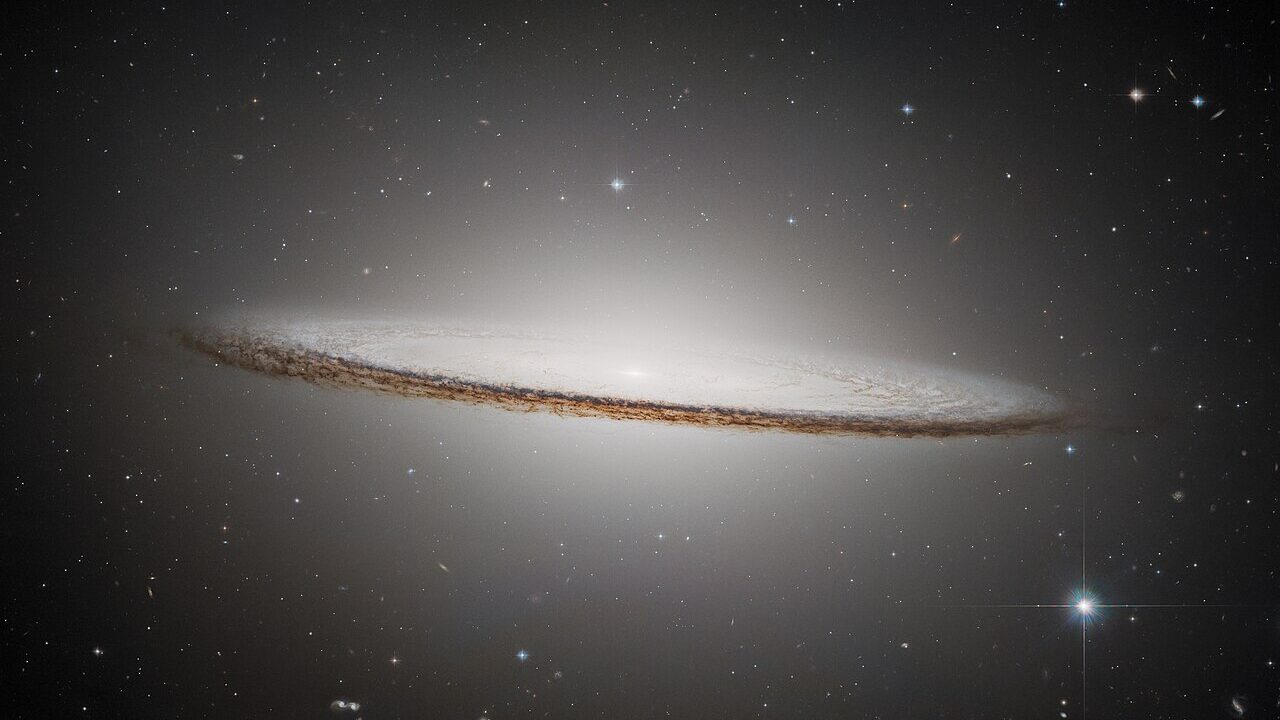
Space. We know it and love it. We learn about it. But did it ever occur to you that our earth—and us—are made of it? Well we are, which basically makes us solid versions of the sea of plasma around us. For comparison, that makes a fish part of the ocean around it. The reason: elements. 118 tiny building blocks of life and the universe. The way elements are born is interesting. In the big bang, Helium, Hydrogen, Lithium and Beryllium were formed.
Section 01Post-Big Bang ways of forming elements
100 million to 200 million years after the big bang, elements started forming in these ways too.
Low-Mass Stars (like our Sun) started to fuse hydrogen into helium, and later helium into carbon and oxygen.
Massive stars and supernovae
At the same time, Massive Stars also started to fuse the first elements (hydrogen into helium) in combinations that fused two atoms of the same kind creating progressively heavier elements. When the Massive Starts run out of hydrogen, they start fusing with helium. When helium (2) fuses with helium (2) it creates beryllium (4) (2+2=4). When beryllium (4) then fuses with helium (2), it makes carbon (6).
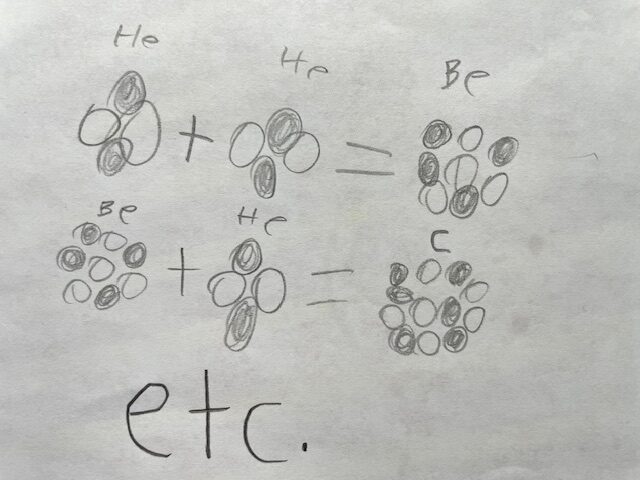
When each new element fuses with helium and its two protons, it creates oxygen (8), neon (10), magnesium (12), silicon (14), sulfur (16), argon (18), calcium (20), titanium (22), chromium (24 and eventually stopping at iron (26). These fusions happen one hundred undecillion times per second.
That’s 100,000,000,000,000,000,000,000,000,000,000,000,000 times a second!
This fusion needs a lot of energy. Imagine if you had two lumps of modeling clay. Imagine now forcing them together in one shot in a way that they are now one whole, new, seamless piece of clay. Basically, that is amount of force needed to fuse hydrogen and hydrogen or helium and helium or helium and beryllium, etc. If you could somehow harness the energy you used to do this, in the case of real animal life, that would be electricity. (All animals have small amounts of electric current deep inside our bodies, think: static electricity). You would have enough energy to create a small lightning bolt. When a star combines two atoms, it also creates energy. But in the case of stars, since they are not living creatures and are instead cosmic matter, they create energy that is not electricity, but instead fire and heat. Not all cosmic matter creates energy. The reason we can see Mars and Venus is not bc they produce energy (they are rocks). The reason we can see them is because the sun’s light reflects off of their surfaces. That is the reason the Sun looks like a big bright flaming ball of gas in the sky, because it is flaming. The fact that 1032 explosions happen every second is why we can see the Sun.
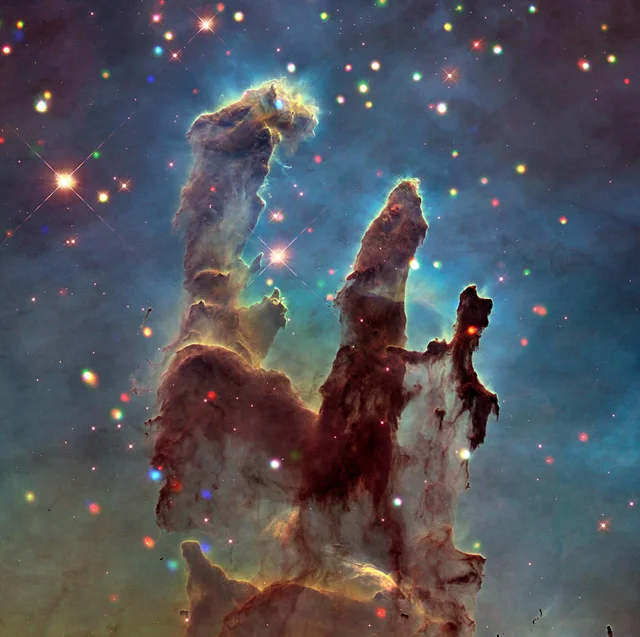
Continuing on with the formation of even heavier elements, when iron is formed it consumes energy rather than releasing it. This triggers the death of the Massive Star, resulting in a massive explosion called a supernova. In that instant, almost half of the elements heavier than iron are created, and this makes a beautiful cloud called a nebula. (It also may interest you to know that the nebula above is called the pillars of creation!)
Kilanovas and Even Heavier Elements
When two Neutron Stars collide, they create a catastrophic explosion called a kilonova. This explosion is the primary source for some of the heaviest elements in the universe. It creates vast cosmic clouds of precious and heavy metals like gold (79), platinum (78), uranium (92), plutonium (94)!
Section 02Grid of how elements are formed
| Process | Key Elements Formed | Cosmic Source |
|---|---|---|
| Living Stars | Carbon, Oxygen, Neon, Silicon, Iron* | Stellar Cores |
| Supernovae | Elements heavier than iron | Exploding Massive Stars |
| Neutron Star Collisions | Gold, Platinum, Uranium* | Kilonova Mergers |
| Cosmic Ray Smashes | Beryllium, Boron, Lithium | Interstellar Space |
*And others.
And that is how many of the elements are formed. Some even heavier elements have been made by us humans. I will have a post about fascinating and exciting creation of these super heavy elements by September 1, 2026.